
The High Stakes of IATF 16949 Automotive Connector Standards
In the world of consumer electronics, a faulty component might mean a frustrated customer restarting a device. In the automotive industry, a single component failure can lead to catastrophic consequences, massive recalls, and loss of life. This is why the IATF 16949 automotive connector standards exist.
As vehicles become increasingly software-defined and electrified, the humble connector—the “nerve endings” of a car’s electrical system—has never been under more scrutiny. For engineers and procurement managers, understanding these standards is not just about compliance; it is about ensuring the safety and reliability of the final vehicle.
Learn more about our commitment to quality and how we support your manufacturing needs.
What is IATF 16949 Automotive Connector Standards?
At its core, IATF 16949 is the globally recognized quality management system (QMS) standard for the automotive industry. It is not a standalone document but is based on the ISO 9001 framework, with significant additions tailored specifically to the automotive supply chain.
Important note: IATF 16949 is not a connector-specific standard—it applies to all organizations in the automotive supply chain, including connector manufacturers, harness assemblers, and component suppliers. The term “IATF 16949 automotive connector standards” refers to how this universal QMS standard is applied within the connector manufacturing sector.
While ISO 9001 focuses on general quality processes, the IATF 16949 automotive connector standards demand a relentless focus on defect prevention and the reduction of variation and waste in the supply chain.
Key differences from general standards include:
- Risk-Based Thinking: It requires a proactive approach to identifying potential failures before they happen.
- Supply Chain Management: It enforces strict controls over sub-tier suppliers (e.g., the raw material providers for your pins and housings).
- Continuous Improvement: It mandates a cycle of constant optimization, known as the Plan-Do-Check-Act (PDCA) cycle.
For more insights, check out our News Center for the latest industry updates.
Why IATF 16949 automotive connector standards Matter for Connectors
Connectors are often overlooked, yet they are critical. A pin header or a wire harness must withstand extreme temperatures, constant vibration, and moisture over a vehicle’s typical lifespan of 10-15 years.
Adhering to IATF 16949 automotive connector standards ensures that the manufacturing process is stable and capable. It moves beyond “inspecting quality in” (checking the product at the end) to “building quality in” (controlling the process).
The Impact on Reliability:
- Traceability: Every batch of phosphor bronze or PA66 plastic can be traced back to its source. If a defect is found, it can be isolated immediately.
- Consistency: The 10,000th connector produced must be identical to the 1st one.
- Safety: It minimizes the risk of issues like fretting corrosion or terminal back-out, which can cause electrical fires or system failures.
The Core Tools: The “Muscle” Behind IATF 16949
You cannot talk about IATF 16949 automotive connector standards without mentioning the “Core Tools.” These are the practical methodologies used to achieve quality, developed by the major American automotive companies (GM, Ford, and Chrysler) as the foundation of the QS-9000 standard.

1. APQP (Advanced Product Quality Planning)
This is the roadmap for developing a new connector. It ensures that everything from the mold design to the plating thickness is planned out to meet customer requirements before mass production begins.
2. FMEA (Failure Mode and Effects Analysis)
This is perhaps the most critical tool. It involves asking “What if?”
- What if the plating is too thin? (Risk: Oxidation)
- What if the housing cracks? (Risk: Short circuit)
- By analyzing these risks early, manufacturers can implement design changes to prevent them.
Read our detailed guide on Pin Header vs Female Header to understand component selection better.
3. PPAP (Production Part Approval Process)
Before a supplier can ship a single reel of connectors to an automotive client, they must submit a PPAP package. This is a massive collection of documents and data proving that the manufacturing process is capable of producing parts that meet all specifications consistently.
4. Control Plan (CP)
The Control Plan is a living document that describes the actions required at each phase of the process to ensure that all process outputs remain in a state of control. It is typically developed as part of APQP and works hand-in-hand with FMEA and SPC.
5. SPC (Statistical Process Control)
During production, SPC uses statistical methods to monitor the process. For example, measuring the dimensions of a pin header in real-time to ensure the process stays within tolerance limits.
6. MSA (Measurement System Analysis)
This ensures that the tools used to measure the connectors (like calipers or optical scanners) are accurate. If your ruler is wrong, your data is wrong.
Comparison: ISO 9001 vs. IATF 16949 automotive connector standards
To understand the gravity of the IATF 16949 automotive connector standards, it helps to compare them with the general ISO 9001 standard.
| Feature | ISO 9001 (General) | IATF 16949 (Automotive) |
|---|---|---|
| Focus | Customer Satisfaction | Defect Prevention & Safety |
| Scope | Any Industry | Automotive Supply Chain Only |
| Tools | General Quality Tools | Core Tools (APQP, FMEA, PPAP, CP, SPC, MSA) |
| Supplier Control | Basic Evaluation | Strict Development & Monitoring |
| Traceability | General | Mandatory & Granular |
Our Commitment to IATF 16949 automotive connector standards
At our company, we understand that you are building systems where failure is not an option. Whether you are designing medical devices, industrial robotics, or automotive subsystems, the reliability of your interconnects is paramount.
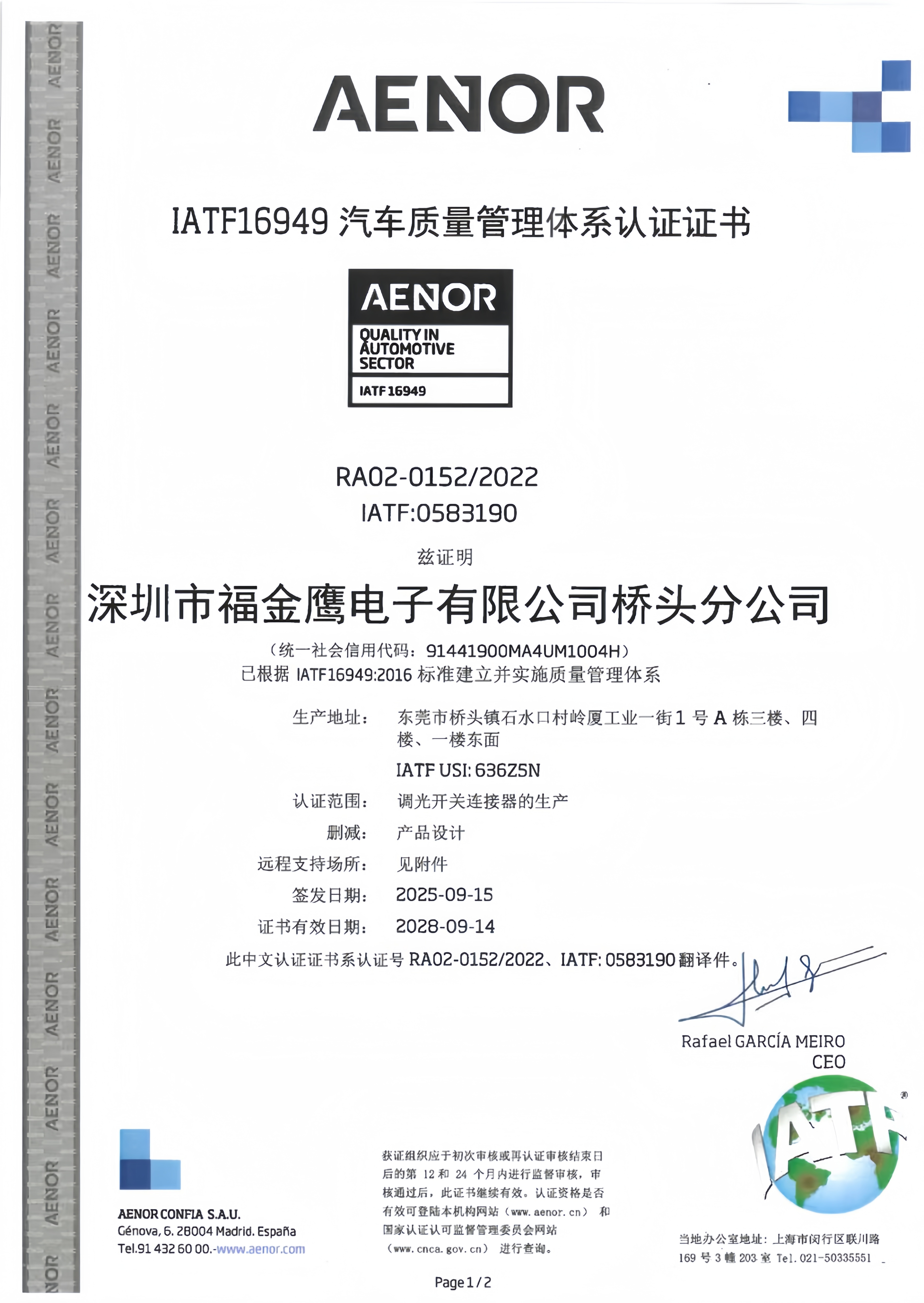
We align our manufacturing processes with the rigorous requirements of IATF 16949 automotive connector standards. This means:
- Material Integrity: We use only virgin, high-temperature materials (like LCP and PA66) and certified copper alloys.
- Process Control: Our automated production lines utilize SPC to monitor critical dimensions 24/7.
- Full Traceability: From the raw material lot number to the final packaging, every step is recorded.
We don’t just sell connectors; we provide peace of mind. By adhering to these strict standards, we ensure that our pin headers, box headers, and wire harnesses perform reliably in the most demanding environments. Browse our full product catalog to find the right connector for your application.
Conclusion
The IATF 16949 automotive connector standards represent the gold standard for manufacturing quality. They transform a simple metal-and-plastic component into a reliable, safety-critical part of a larger system.
When selecting a supplier, asking about their adherence to these standards—and specifically their use of Core Tools like FMEA and PPAP—is the best way to gauge their capability.
Are you working on a project that requires high-reliability interconnects?
Contact our engineering team today to discuss your specifications or request a sample kit to test our quality for yourself.
References: